About
What's behind mappp?
Politics rarely consists of a single decision. It is a process spread across various bodies, deadlines, and areas of responsibility—from demonstrations to committee meetings. Anyone who wants to have a say must know where this process currently stands and at what stage it is open for input. That is exactly what the Atlas of Politics, Processes, and Participation makes visible.
How the Project Came About
It all began with the question of how exactly a law comes into being, where the idea for it comes from, and who is involved in shaping it into a legal provision. There are diagrams, there are rules of procedure, and there is specialized literature. What all these descriptions leave out are the connections between them and the informal levels in between.
In 2024, the Gestaltungszentrale Politik, in collaboration with Prof. Dr. Sven T. Siefken (Opens in new tab), began systematically mapping political processes. This effort was based on various collaborative workshops involving government ministries, academia, and political practitioners. This mapping exercise formed the unique knowledge base of the project. Since October 2026, it has been freely accessible as an atlas.

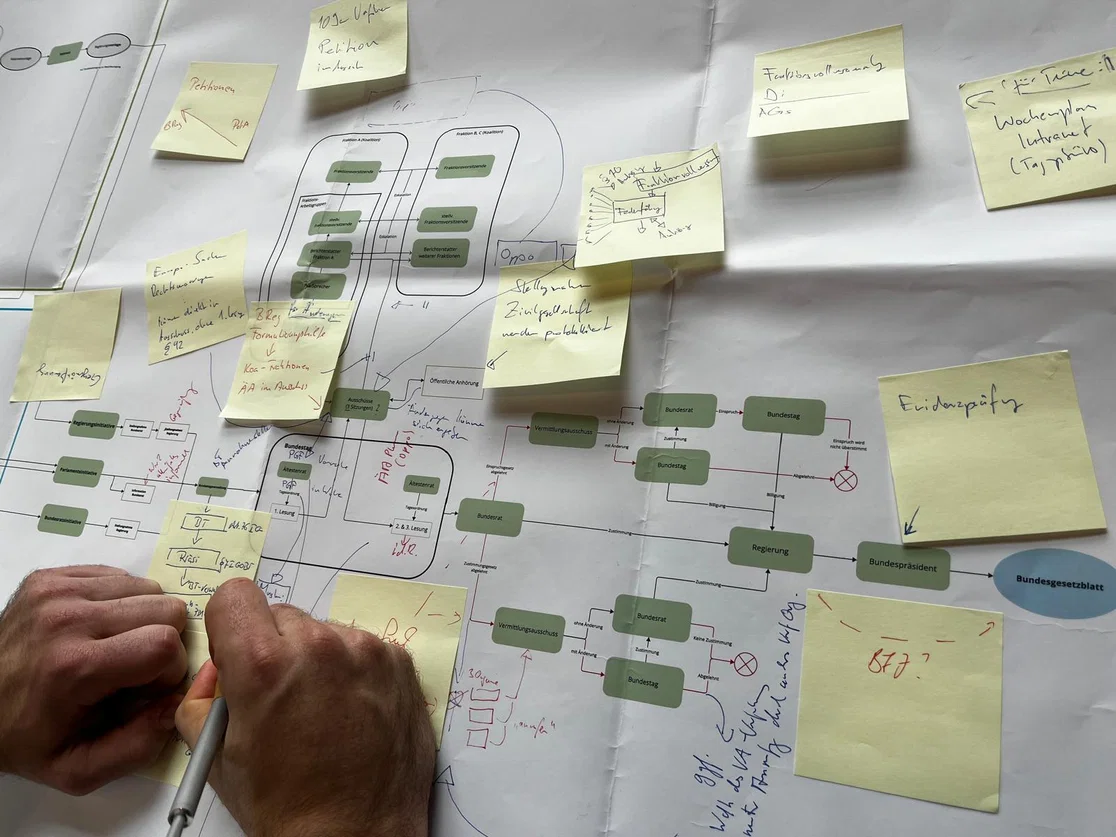
Behind this lies a design philosophy: clarity is not a matter of simplification, but of gradual introduction. Complex processes do not need to be shortened in order to be understood. They must be designed to be accessible and presented step by step.
Who the atlas is intended for
Advocacy
Anyone who wants to submit comments must choose the right moment. The Atlas shows at what stage of a proceeding comments are effective and what deadlines apply.
Advocacy
Politics & Public Administration
A unified presentation of the organization's own procedures, which can be used in onboarding, in external communications, and in communication across organizational levels.
Politics & Public Administration
School & Education
Civic education requires more than just a diagram of the legislative process. The Atlas makes these processes easy to understand and shows where participation comes into play. The educational materials are freely available and can be used directly in the classroom.
School & Education
Research & Science
The mapping is systematic and well-documented. It can be used as a basis for independent analyses and allows for comparisons of methods across different levels.
Research & ScienceWhat the Atlas Offers
Explore
Political processes as a map. You can see which steps follow one another, who is involved, and how the different levels are connected. Instead of a list of sections, it’s an overview you can zoom into.
Cases
Real legislative processes, relived step by step. From the initial proposal to the enactment, including the detours, delays, and compromises that actually took place.
Participate
Points of Participation. At which stages of a proceeding it is possible to submit comments, make statements, participate in hearings, or establish contact, and what is required in each case.
Who's behind it
The Atlas is a project of Gestaltungszentrale Politik (Opens in new tab), which examines political processes from a design perspective. The nonprofit association is the project’s sponsoring organization and is legally and financially responsible for it.

The mapping was carried out in collaboration with Prof. Dr. Sven T. Siefken (Opens in new tab) of the Federal University of Public Administration.


The development of the digital atlas was funded by the Ernsting Kunst- & Kultur-Stiftung (Opens in new tab).